
Old timers of Delhi- like your humble friend- who have witnessed, (and mourn) the metamorphosis of Delhi from being an overgrown, somnolent town, with a strong Panjabi flavor, pre-dominantly inhabited by government babus and small traders, into an ugly behemoth, bursting at the seams, also squirm with angst at the morbid transformation of one its most iconic landmarks- the India Gate-located opposite the grand Presidential Palace or Rashtrapati Bhawan, perched on the Raisina Hill, on the scenic Rajpath or the Royal Path, all constructed by the imperial British in the heyday of the Raj, when India was the brightest jewel to shine in the Royal Crown.

In the days of yore, one could leisurely walk up to the eternal flame and pay homage to the fallen soldier, but gradually, as the threat perception (a term which first appeared in the lexicon in the eighties) started to snowball, public movement was progressively regulated by a cordon of security personnel, till a point was reached wherein people were stopped a good distance away from the monument. A heart breaking slide of humanity into a cesspool, where a lunatic fringe representing nobody, but nurturing distorted illusions of righteousness can change the lifestyle and thought process of an entire nation. What causes the biggest anguish is the extent to which we have degenerated, from being an open people, high on verve, into a vulnerable society, claustrophobic, with fear and distrust.
Well, ever since I was a child growing up in my beloved Delhi, I would have visited the majestic vista on countless occasions, and often boasted of knowing it like the back of my hand. But then, as we all know, the world is a tricky place, full of surprises, something I discovered once again, in July 2003, when, on a cool and breezy Saturday evening, after a spell of heavy rain, I went to visit the area with my family, which, as usual, was teeming with weekend revelers. Expectedly, the lawns were soggy, and it was difficult to walk on the wet grass, made worse by the limited lighting. There were mosquitoes galore, even as sundry other insects caused an incessant, irritating buzz. We decided to sit on the footpath, where all the ice-cream vendors line up in a row, as close to the monument as possible.

Just as we were making ourselves comfortable in the muggy environs, our attention was drawn by some loud music emanating from somewhere close by. Initially we thought it to be the churlish misdemeanor of an irritating yuppie passing by in a car, as is common these days. But when the commotion persisted, my eight years old daughter, Mehak, and I decided to check out. We had barely moved a couple of yards when we came face to face with the source of the brassy sound-it was a bi-scope- being pushed on a small cart by a humble hawker.
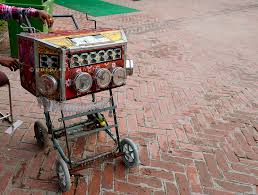
Bi-scope-for those who have not seen it…..
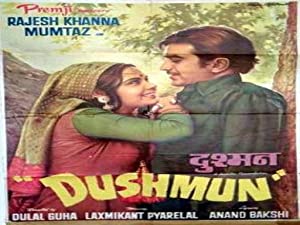
I did not recollect having seen this ‘machine’ on any of my previous visits to India Gate at that point in time- that was another surprise for the day- although I was fully aware of its existence, primarily through my major source of information-Hindi films- of which I have always been a diehard fan. It has made its appearance in sundry movies, its myriad virtues extolled in mellifluous ditties by voluptuous heroines, as they pull or push the box through pristine environs. A lasting impression about the bi-scope was created in my mind when one of my all-time favorite actors, Mumtaz, essayed the role of a sassy bi-scope waali in the 1971 box-office smash hit, Dushman, also starring the reigning czar of Hindi cinema, Rajesh Khanna. Sadly, being a purely urban animal, I had never had the opportunity of seeing the contraption in its physical form. As times changed, ethos of the films also metamorphosed, and the box all but disappeared from the screens, as also from our collective imagination.
At least I was still aware of the existence of the bio-scope, but Mehak, a product of the Cartoon-network, Spiderman and Harry Potter generation was clueless about it. She expressed a keen curiosity about it, and wanted to experience the stuff firsthand. Within no time the eagerness rubbed on me, and I asked the chap to play the ‘show’ for both of us. He gave a cue, whereby we kneeled to peep into the box. He operated a handle, which slowly moved pictures on the small screen, lit by a bulb. My stereotypes of the bi-scope- which I had assumed was some sort of a movie projector- were broken that day. We saw only posters, very garish, to say the least, crumpled at many places, of ruling Bollywood ‘stars’. The ‘show’ lasted around three minutes, and at Rs. 5/- per person, my daughter and I enjoyed it to the hilt. The thrill of having done something new invigorated us- like a discovery pumping adrenalin in a quintessential explorer.
What cheered us even more was to find an archaic relic, preserved in the heart of New Delhi. It reflected hope, and hope is the wheel on which the world moves. After spending some further time at India Gate, we returned home quite late at night, in the midst of a heavy drizzle, buffeted by an unknown energy, as the heady feeling of experiencing something different overwhelmed us.


 Musings of a Delhi Boy
Leave a comment